
Special Educational Needs
Montpelier Primary School is ambitious for all our pupils, and we believe that there is no ceiling on what can be achieved by anyone, regardless of their circumstances or background. We are committed to providing a supportive and inclusive learning environment, giving every young person the opportunity to fulfil their potential now, and in the future.
The leaders at Montpelier Primary School are leaders for all pupils, enabling our teachers to be teachers of all pupils. Montpelier Primary School is committed to distributed leadership to secure the best possible provision and outcomes for pupils with special educational needs. We have the same ambition for all our pupils, and recognise the importance and impact of prioritising our responsibilities to pupils with special educational needs.
We work in partnership with pupils and their families in identifying and providing for special educational needs. Where appropriate, we also work in partnership with other agencies. We recognise the importance of communication being inclusive, accessible and culturally sensitive to achieve effective partnership working.
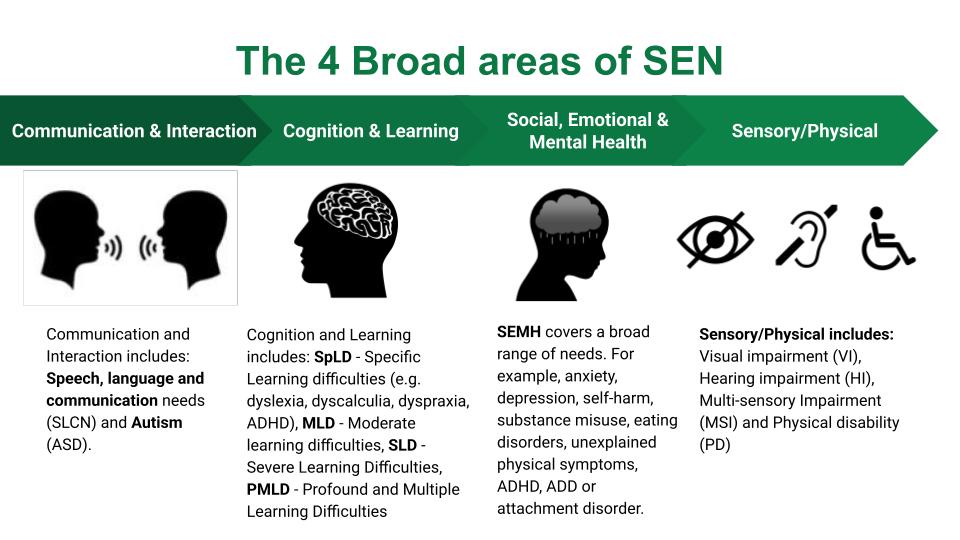
What does it mean to have a Special Educational Need?
A pupil has SEN if they have a learning difficulty or disability that requires special educational provision to be made for them.
They have a learning difficulty or disability if they have:
- A significantly greater difficulty in learning than most others of the same age; or
- A disability that prevents or hinders them from making use of facilities of a kind generally provided for others of the same age in mainstream schools.
Special educational provision is educational or training provision that is additional to, or different from, that made generally for other children or young people of the same age by mainstream schools.
What does this look like at Montpelier Primary School?
At Montpelier Primary School, we recognise that every child is unique. Special educational provision is carefully tailored to meet each child's individual strengths, interests and needs, enabling them to participate fully in school life alongside their peers.
For example, a pupil with SEND may begin their day with a soft start in The Den or The Retreat, where they are welcomed by familiar adults and given time to settle into the school day. This nurturing start may include opportunities to regulate their emotions, check in with a trusted adult, complete a calming activity or prepare for the day ahead. Staff across the school use the child's Learning Plan to understand what is important to them, their strengths, the things they may find challenging and the strategies that help them to succeed. This ensures that all adults working with the child provide a consistent, personalised approach from the moment they arrive at school.
Throughout the day, the pupil will access high-quality teaching within their mainstream classroom, supported by adaptive teaching, scaffolding and reasonable adjustments to meet their individual needs. They may use assistive technology, such as a Chromebook or reader pen, visual timetables, additional processing time, pre-teaching of key vocabulary or adapted resources to help them access learning independently.
Some pupils may also take part in targeted interventions or small-group teaching at planned times during the day. Depending on their needs, this may take place within one of our adapted learning environments, such as The Cabin, The Hub, The Nest, The Den or The Retreat, before returning to their classroom to continue learning alongside their peers. These interventions are carefully planned to complement classroom learning rather than replace it.
During playtimes and lunchtimes, some pupils may choose to access quieter spaces, structured activities or adult-supported provision to help them develop friendships, regulate their emotions or prepare to return to learning. Wherever possible, pupils are encouraged and supported to participate in clubs, educational visits, leadership opportunities and enrichment activities alongside their peers, with reasonable adjustments and proactive support provided where needed.
Our aim is that every pupil feels safe, included, valued and successful. Through high-quality teaching, personalised support and close partnership with families, we remove barriers to learning so that all children can achieve their potential and take an active part in every aspect of school life.
At Montpelier Primary School, we believe that high-quality, inclusive teaching is the foundation of successful learning for all pupils. Our universal provision is designed to meet the needs of the vast majority of children by addressing gaps in foundational knowledge and skills through evidence-informed classroom practice, well-established routines and a carefully planned, ambitious curriculum. Teachers use adaptive teaching strategies to develop reading fluency and accuracy, communication and language, writing composition, mathematical understanding and secure subject-specific knowledge, ensuring that pupils build the essential skills they need to succeed.
Our SEND team
|
Fliss Lock, SENCO |
Every child deserves to feel valued, included and successful. Our role is to understand each child's individual strengths, recognise the barriers they may face and work together with families to provide the right support at the right time. We have high aspirations for every pupil and are committed to helping them develop the confidence, independence and skills they need to thrive both in school and beyond. |
|
Nicki Tapp, Inclusion Lead for SEND |
Inclusion is central to our approach. Every child deserves to feel they belong, regardless of their strengths, challenges or differences. By working closely with families, building positive relationships and providing the right support, we aim to create an environment where every child feels accepted, confident, and able to reach their full potential. |


Identification and assessment of children with SEND
We know that early identification of Special Educational Needs (SEN) is essential to ensure that every child receives the support they need to achieve their full potential.
If parents or carers have any concerns about their child's development or progress, whether this relates to learning, communication and interaction, social, emotional or mental health, or physical and sensory development, they should speak to their child's Class Teacher in the first instance.
Teachers regularly monitor and assess the progress and development of all pupils through ongoing assessment, classroom observation and pupil progress meetings. If a class teacher identifies a concern, they will discuss this with parents or carers. Initially, adaptations to teaching and targeted short-term interventions may be put in place to support the child. In many cases, these strategies successfully address the concerns.
If concerns continue despite these initial support strategies, the Class Teacher will consult with the Special Educational Needs Coordinator (SENCo). Together, they will carry out a more detailed assessment of the child's needs and consider whether additional provision is required.
Where appropriate, a Learning Plan will be developed, outlining the child's strengths, areas of need, agreed outcomes and the support to be provided. With parental consent, the school may also seek advice from external professionals or make referrals to specialist services to ensure the child's needs are fully understood and appropriately supported. Parents and carers are fully involved throughout this process and are recognised as valued partners in their child's education.
Depending on a child's individual needs, support may include:
-
Appropriate scaffolding to enable access to learning.
-
Reasonable adjustments to the classroom or learning environment.
-
Adaptive teaching strategies tailored to the child's needs.
-
Specialist resources or equipment where appropriate.
-
Targeted small-group or individual interventions, delivered either within or outside the classroom.
-
Advice and support from external agencies, such as Educational Psychology, Speech and Language Therapy, Occupational Therapy, Advisory Teachers or other specialist services.
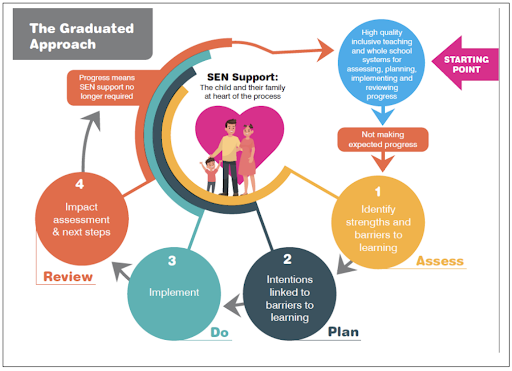
We follow the graduated approach outlined in the SEND Code of Practice: Assess, Plan, Do, Review, ensuring that support is regularly monitored, evaluated and adapted so that it continues to meet each pupil's changing needs
Consulting and involving pupils and parents
We recognise that parents and carers know their child best and are key partners in supporting their child's education. We are committed to working collaboratively with pupils and their families throughout every stage of the SEND process.
Where a pupil has been identified as having Special Educational Needs (SEN), we work together with the pupil, parents/carers and relevant staff to identify the child's strengths, areas of need and the support required to enable them to participate fully in school life, make progress and achieve positive outcomes.
Through regular discussions, we aim to ensure that:
- everyone has a shared understanding of the pupil's strengths and needs;
- agreed outcomes are identified and understood;
- the support to be provided is clearly planned;
- progress is regularly reviewed and next steps are agreed together.
The views, wishes and feelings of the child are central to this process. Wherever appropriate, pupils are encouraged to contribute to discussions about their learning, share what helps them to succeed and participate in setting and reviewing their own targets.
Parents and carers are kept informed through regular communication with the Class Teacher, including meetings to review Learning Plans and progress. Records of discussions and agreed actions are maintained on the school's management information system (Insight) and copies can be provided to parents or carers on request.
When it is agreed that a pupil requires SEN Support, parents and carers will be formally notified by the Class Teacher. Thereafter, support will be reviewed regularly through the Graduated Approach (Assess, Plan, Do, Review cycle), ensuring that provision continues to meet the child's individual needs and that parents, carers and pupils remain fully involved in decision-making throughout.
Assessing and reviewing pupils' progress towards outcomes
At Montpelier, we follow the Graduated Approach and the four-part cycle of assess, plan, do, review.
The Graduated Approach starts at a whole-school universal level. Teaching staff are continually assessing and reviewing their approach to teaching all children. However, where a potential SEND need has been identified, this process is becoming increasingly personalised and interventions are tailored to meet the particular needs of the child.
At Montpelier Primary School, we may use some of the following strategies to assess and review your child’s progress:
|
Type of assessment or review |
Frequency |
|
Pupil progress in lessons |
In daily lessons, teaching staff will use assessment for learning approaches to make an assessment of all children’s progress in the lesson. They will use this to review the impact of approaches to support your child. |
|
Pupil progress |
Termly – each term teachers will assess all children against the curriculum standards. Each term teachers will review the impact and effectiveness of interventions in place. |
|
Parent/carer consultations |
Autumn and spring term – parents and teachers discuss the progress and areas for development. An annual report will be provided during the summer term. |
|
Learning Plan review |
If your child has a learning plan, the targets and provision will be reviewed and discussed with parents/carers three times a school year. |
|
EHAT (Early Help Assessment Tool) or TAM/TAF (Team Around Me/the Family) |
Children with more complex needs may have an EHAT or TAM which includes targets for a child’s educational, health and care needs and provision. These will be reviewed each term by parents/carers, school staff and outside agencies. These can be led by the Headship Team, the SENCO, PSA, Year group leaders and Class Teachers. External professionals may also lead these meetings. |
|
EHCP (Education, Health Care Plan) |
A small minority of pupils have a high level of complex, long-term needs and they will have an EHCP. This will be reviewed annually with the child, parents/carers and other professionals who work with them. |
All teachers and support staff who work with the pupil will be made aware of their needs, the outcomes sought, the support provided, and any teaching strategies or approaches that are required. We will regularly review the effectiveness of the support and interventions and their impact on the pupil’s progress.
Pupil Passport
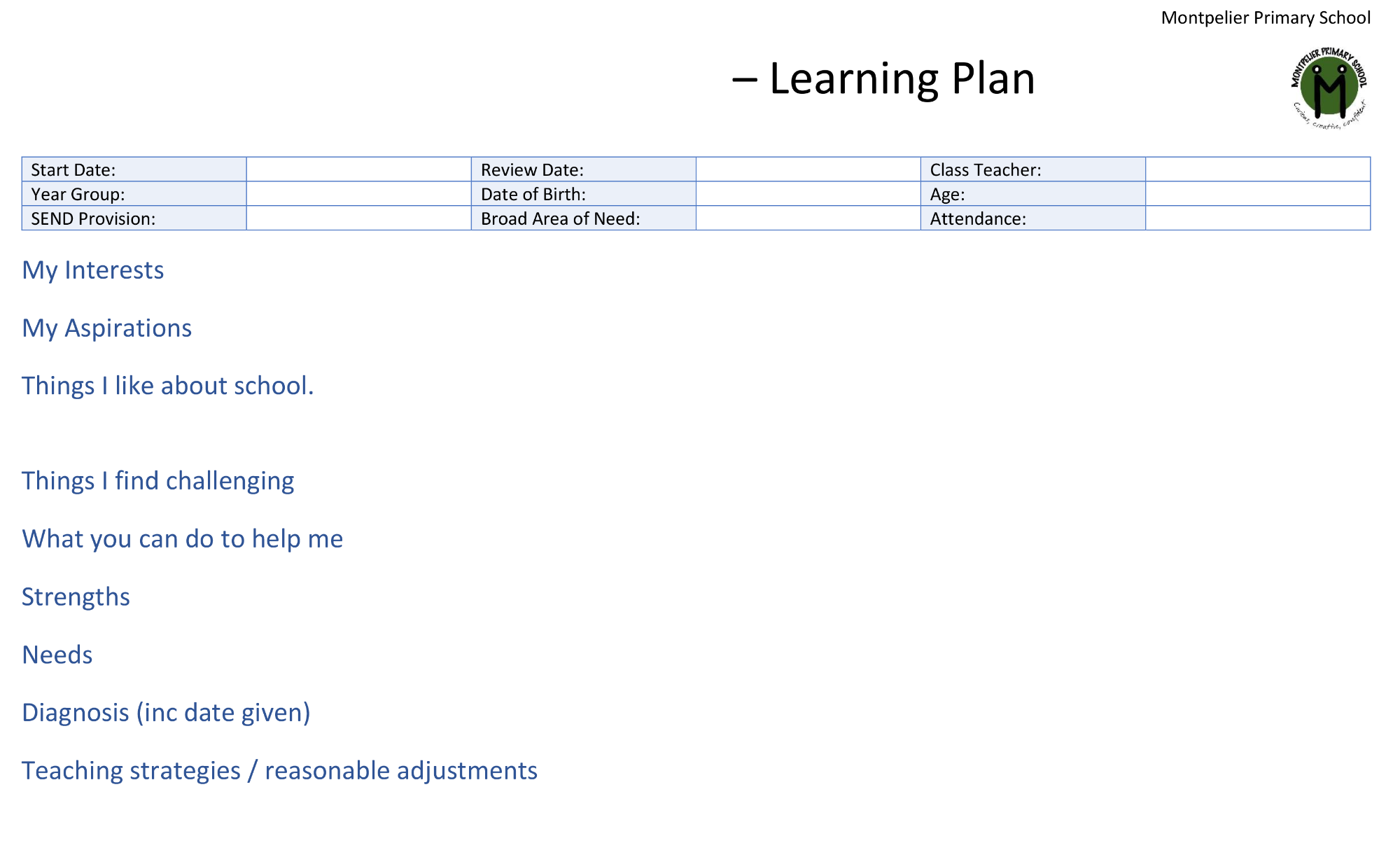
A pupil passport is a regularly reviewed document that contains the needs, strengths and individual strategies for every student with an EHCP or on SEN support. These are developed in partnership with pupils and their parents/carers and are part of the pupil’s learning plan. Where appropriate, they might also include strategies recommended by other professionals.
Learning Plan
Some pupils who require more specialised support will have individualised learning plans to complement pupil passports. For example, an individualised learning plan will be used to:
-
Track progress against long-term outcomes in Educational, Health and Care Plans (EHCNAs) for pupils working below age-related expectations.
-
Inform medium-term and daily curriculum planning and provision where children are accessing adapted curriculum pathways.
-
Inform intervention planning
Universal provision – high quality teaching
At Montpelier Primary School, we believe that high-quality, inclusive teaching is the foundation of successful learning for all pupils. Our universal provision is designed to meet the needs of the vast majority of children by addressing gaps in foundational knowledge and skills through evidence-informed classroom practice, well-established routines and a carefully planned, ambitious curriculum. Teachers use adaptive teaching strategies to develop reading fluency and accuracy, communication and language, writing composition, mathematical understanding and secure subject-specific knowledge, ensuring that pupils build the essential skills they need to succeed.
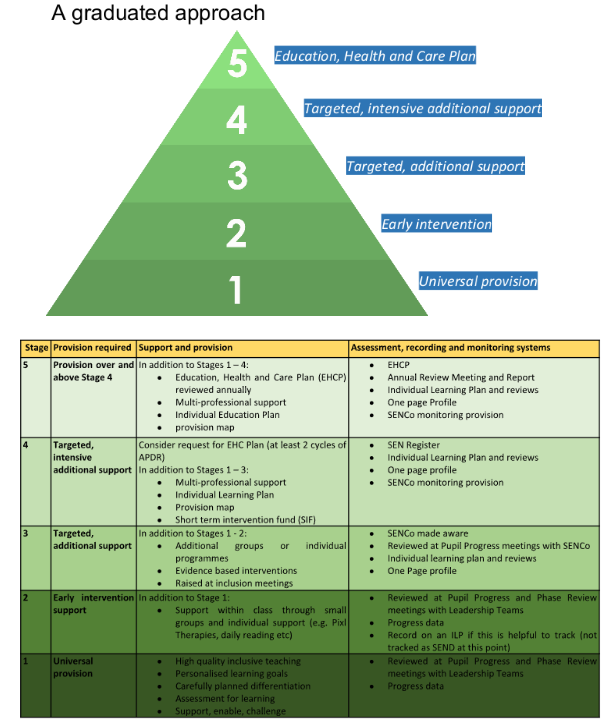
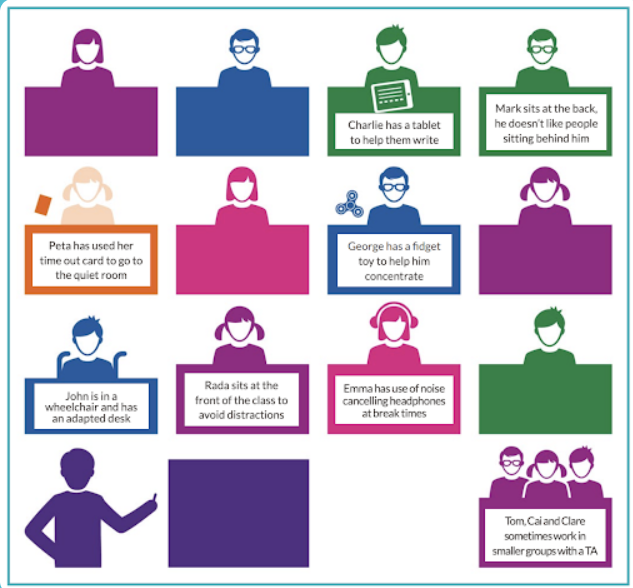
A typical classroom will have a number of pupils accessing a range of adaptions, please see the diagram to offer an example.
Targeted support
At Montpelier Primary School, targeted provision is available for pupils who require support that is additional to, or different from, the high-quality teaching and universal provision available to all. Early identification and intervention are central to our approach, enabling us to identify emerging barriers to learning and provide timely support before needs become more significant. Through the graduated approach of Assess, Plan, Do, Review, Class Teachers, the SENCO and Inclusion Team Leaders work in partnership with pupils, parents/carers and, where appropriate, external professionals to identify individual needs, agree outcomes and plan personalised support.
Targeted provision may include evidence-informed interventions, pre-teaching, precision teaching, speech and language programmes, social and emotional support, adaptive resources, assistive technology and small-group teaching. Teachers continually assess pupils' progress and adapt their teaching to ensure support remains responsive to individual needs. Targeted support is carefully matched to each pupil, delivered for an agreed period of time and regularly reviewed to evaluate its impact. Our aim is to close gaps in learning, build confidence and independence, and enable pupils to access the curriculum and participate fully in all aspects of school life alongside their peers, reducing the need for more specialist intervention wherever possible.
Specialist support
Specialist support is provided for pupils whose needs require a more personalised level of provision that is additional to targeted classroom support. Through the Assess, Plan, Do, Review cycle, the SENCO, Inclusion Team Leaders, Class Teachers, parents/carers and, where appropriate, external professionals work collaboratively to identify the specialist strategies, interventions and adaptations needed to help each pupil achieve their best possible outcomes. Specialist advice may be sought from a range of services, including the Educational Psychology Service, Communication and Interaction Team (CIT), Multi-Agency Support Team (MAST), Child and Adolescent Mental Health Services (CAMHS), School Nursing Service, Child Development Centre (CDC), Speech and Language Therapy, and other health or education professionals as appropriate. Recommendations from these services are embedded into classroom practice and personalised provision and are reviewed regularly to ensure they continue to meet the pupil's needs.
As part of our specialist provision within our mainstream school, some pupils may access The Cabin, a specialist learning environment designed to support pupils with Speech, Language and Communication Needs (SLCN), Social, Emotional and Mental Health (SEMH) needs, and Cognition and Learning needs. The Cabin provides a highly personalised programme of support, including specialist interventions, communication-focused teaching, intensive interaction, opportunities to develop emotional regulation and learning behaviours, and teaching that is carefully matched to each pupil's stage of development. Working closely with families and external professionals, staff use specialist strategies and personalised approaches to reduce barriers to learning, develop independence and confidence, and enable pupils to access the curriculum and the wider life of the school as successfully as possible. For many pupils, support within The Cabin forms part of a planned pathway to increase participation within their mainstream classroom, while for others with more complex needs, it provides an ongoing bespoke provision within our inclusive mainstream setting.
Staff training
We are committed to ensuring that all staff have the knowledge, skills and confidence to support pupils with Special Educational Needs and Disabilities (SEND). Professional development is an ongoing priority, and training is regularly reviewed to reflect the needs of our pupils and developments in SEND practice. All teachers are teachers of SEND and all leaders are leaders of SEND. Staff are committed to creating an inclusive learning environment where every pupil can thrive. As a Greenshaw Learning Trust school, our ethos is that we are Always Learning, and this commitment extends to every member of staff. We recognise that developing our knowledge and understanding of Special Educational Needs and Disabilities (SEND) is an ongoing process. Professional development is carefully planned to reflect the needs of our pupils and current best practice. Teachers and Teaching Assistants receive regular training to develop their understanding of a wide range of special educational needs, including speech, language and communication needs, autism, social, emotional and mental health, cognition and learning, adaptive teaching strategies, and the effective use of assistive technology. Staff are also trained in the Plymouth Ordinarily Available Provision (OAP) and the Graduated Approach to Inclusion (GATI), ensuring that appropriate universal, targeted and specialist support is embedded across the school.
Training is delivered through a combination of whole-school professional development, coaching and guidance from the SENCO, Inclusion Team Leaders and external professionals. Staff receive ongoing advice from specialist services, including Speech and Language Therapy, the Communication and Interaction Team, Educational Psychology and other agencies, enabling them to implement evidence-informed strategies within the classroom. By continually reflecting on and developing our practice, we ensure that our staff have the knowledge, confidence and skills to provide high-quality teaching, appropriate adaptations and personalised support, enabling all pupils with SEND to achieve the best possible outcomes.
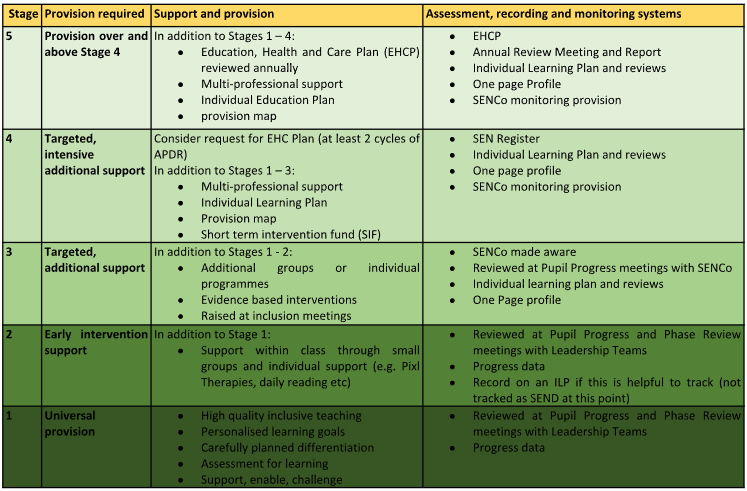
The link below will take you to a table that demonstrates what you can expect to see at each stage.
Useful links
Useful links
- https://plymouthgati.co.uk/
- https://www.plymouthias.org.uk/
- https://www.plymouthonlinedirectory.com/plymouthlocalofferhome
- https://padlet.com/plymouthcccentral/plymouth-best-start-family-hub-s-timetable-leqn50wnp266xatw
- https://www.larkfamilyhubs.co.uk/
- https://www.plymouthhospitals.nhs.uk/cdc-advice-and-guidance/
Teacher Handbook: SEND
With contributions from specialists across the sector, the handbook is a comprehensive resource for teachers and parents to use over time. It brings together practical examples of high-quality teaching – placing focus on removing barriers to learning, getting to know and understand individual learners, and bringing to life the graduated approach. To access this free resource, click on the link below and sign up to Whole School SEND:
Whole School SEND Online CPD Units
Free, flexible online learning to help develop inclusive practice.
To access Montpelier’s SEN Information report, please click here.
To access Plymouth’s local offer, please click here.